
Championing Sustainable Growth from the Boardroom: Stanford Doerr School of Sustainability and Egon Zehnder
Dr. Min Zhou reflects on systems thinking, board stewardship and the leadership needed to turn sustainability into lasting business value. Revised in October 2026, these are her personal takeaways, rather than a summary of the course materials.
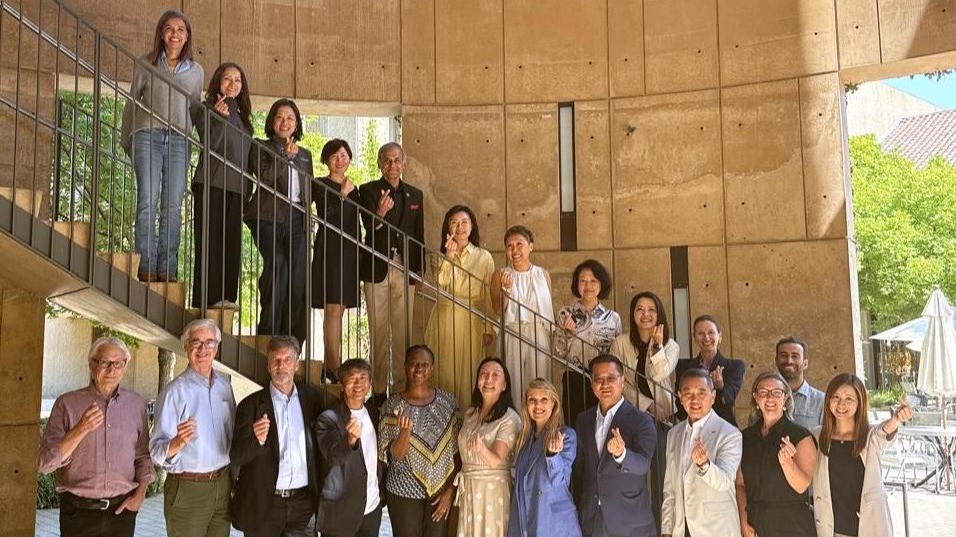
From July 7 to 11, 2025, I joined a gathering of global directors and investors at Stanford University for “Championing Sustainable Growth from the Boardroom,” a program run by the Stanford Doerr School of Sustainability together with Egon Zehnder. In a time defined by climate upheaval, geopolitical turbulence and fast technological change, the conversations were candid and urgent, and still full of hope.
Over four and a half days we heard from leaders including former Secretary of State Condoleezza Rice, former Clorox Chairman Benno Dorer and Stanford professor Yi Cui, and we spent as much time in exercises and quiet reflection as in lectures. I came home with one thought that I keep returning to: be a keen detector of signals, design organizations thoughtfully, build real alignment with stakeholders, and keep growing into the future self you want to become.
From morality to materiality
Sustainability has moved from morality to materiality.
The shift that stayed with me most is how the conversation about sustainability has changed. It used to rest mainly on morality. Today the stronger argument is materiality: what affects how a company earns, protects and grows its value. The aim is that consumers, businesses and the planet all win, as concrete outcomes rather than ideals. As that idea matures, leaders pull ahead and laggards fade, and sustainability stops being a separate program and becomes part of how a business is run.
For a company, I think the work begins with telling signals from noise. The next step is to anchor on what stays constant, and then to separate the risks that hit a whole industry from the risks that belong to one enterprise, always looking for the opportunity inside them. From there, a long-term vision can guide strategy, shape the plan, build culture and capabilities, and bring stakeholders along, which in the end raises value for shareholders too. Systems thinking helps throughout, because human capital, social capital, knowledge, natural resources and physical infrastructure are not separate lists. They are one connected system, and pulling one lever moves the others.

Leading when the picture is not clear
One of the most useful ideas for me came from the sessions on complexity. Some problems are complicated: they are hard, but careful analysis and the right expert can solve them. Others are genuinely complex, where cause and effect only become clear in hindsight, and the sensible approach is to try small experiments, watch what happens and adjust. Many of the questions boards face on sustainability, from shifting regulation to new technology to changing customer expectations, belong in that second group. Treating them as if they were complicated, with a fixed plan and a checklist, is a common and costly mistake.
What makes a board effective
Stewardship is the word I would use for the role of a board, and I came to see it as something that matures in stages. A board may begin by using sustainability, seeing it as a useful input to the existing business. It can then integrate it, building it into strategy, risk and incentives. The furthest stage is to be transformed by it, allowing the questions it raises to change what the company is for and how it competes.
Talk it, lock it, walk it.
Moving along that path depends on how a board works together. Directors are often generalists, and each one brings a distinctive edge, so the job is to draw on that collective wisdom rather than defer to the loudest voice. Dissent is valuable, and alignment should come from dialogue rather than conformity. We talked about this as talk it, lock it, walk it: argue the issue openly, commit to the decision, then act on it together. Boards also need to resist micromanaging and trust their management teams, and to bring in outside perspectives through independent directors and invited speakers, because it is easy to hear only what one already believes.
Leadership is institution design
Priorities, metrics, pay, promotions and power show what a company truly values.
I left with a broader view of leadership as the design of resilient institutions: purposeful, strategic and set from the top. That starts with psychological safety, since people only say what they see if it is safe to do so. Leaders also have to be willing to show vulnerability, which builds the trust needed to give a team a meaningful context to work in. Fairness matters just as much, because a sense of justice is deeply rooted in human psychology.
A company’s real values show up in five places: its priorities, its performance metrics, its pay, its promotions and who holds power. Together they show what a company truly values, whatever its annual report says.
Growing into the future self
Identity is the story I tell myself about who I am.
The last theme was personal. I want to be an antenna for signals, which means being attentive in a way that goes beyond analysis. Many leaders are strong at thinking and doing but neglect the emotional and spiritual side, so I try to keep the physical, mental, emotional and spiritual dimensions of my life aligned.
Development also has an order. It runs from knowledge to skills, then to identity, and finally to the traits and motives underneath, such as the drive for achievement or for power, which are the hardest to change. Identity sits in the middle of that chain, and I find it a useful reminder that identity is the story I tell myself about who I am. That makes it something one can work on: modeling the person you aspire to be is one of the most practical ways to grow into them.
For us at CM Venture Capital, these ideas are not abstract. We work with founders, corporate partners and boards, and the same questions come up in each: which signals matter, what stays constant, and how to build organizations that can act on what they see. I am grateful to the Stanford Doerr School of Sustainability and Egon Zehnder for the week, and to the fellow participants for their openness.