Why China's and America's Robotics Booms are Fundamentally Different
This article compares the forces shaping the robotics industries in China and the US, considering how investment expectations relate to commercial progress in embodied AI.

Last week, Unitree Robotics made its public-market debut through one of China’s most closely watched technology IPOs of the year. The offering comes at a defining moment for the global robotics sector, as record levels of capital flow into embodied AI and investors increasingly debate whether valuations have moved ahead of commercial reality.
In the United States, companies such as Figure AI, Skild AI and Physical Intelligence have raised multi-billion-dollar funding rounds to develop the next generation of embodied AI. In China, companies including Unitree Robotics, AgiBot and Fourier Intelligence are also attracting significant investment, supported by both private capital and national industrial policy.
To many investors, this looks like a global robotics bubble. We believe there are two.
Both markets are seeing higher valuations, larger funding rounds, and intense competition to back the next winner. But, the forces driving these markets are fundamentally different.
At CM Venture Capital, we have spent the past year evaluating robotics and embodied AI companies across both China and the United States. Our research has concentrated on areas including the robot brain, robot hands, and privacy solutions, where we believe long-term differentiation is most likely to emerge. Two structural differences stand out.
1 Valuation Corrections Follow Different Rules
The most important difference between the two markets is not how valuations rise, but how they adjust when expectations change.
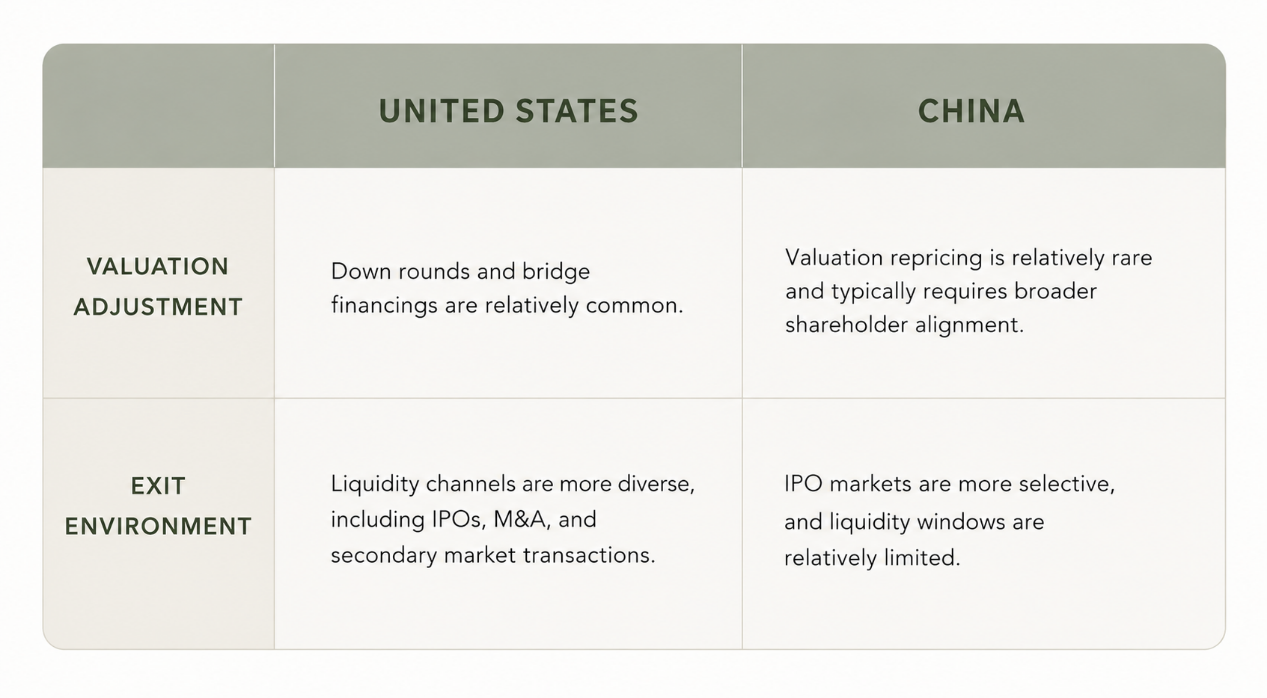
In the US, high valuations do not necessarily trap companies. Valuation resets are generally accepted as part of venture investing. Bridge financing, structured rounds, and down rounds, when necessary, allow companies to recapitalize, extend runway and continue building the business. Existing investors may accept dilution or lower valuations, while boards have a fiduciary duty to act in the best interests of the company and all shareholders, even if that means raising capital below the previous valuation.
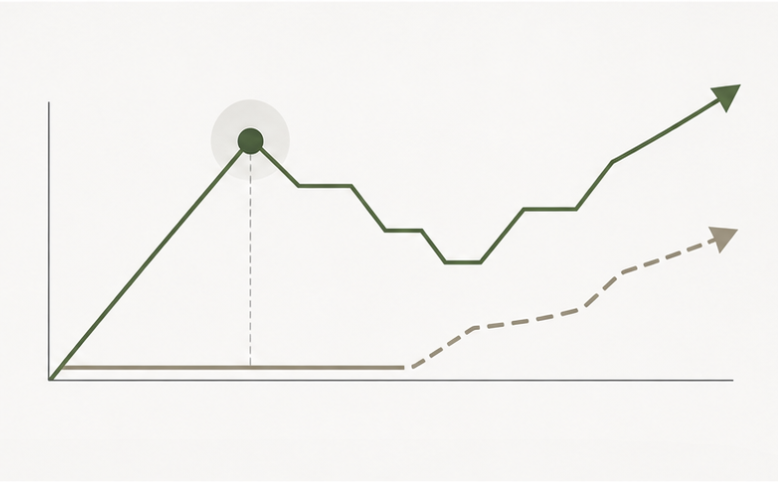
Failure is also common and can happen quickly, allowing capital and talent to consolidate around a smaller number of winners. Those that emerge can then scale rapidly.
China operates differently. Raising capital below a previous valuation is often more complex. In practice, recapitalization requires broader shareholder alignment, and contractual anti-dilution provisions are strictly followed. As a result, repricing can take longer and down rounds are rare. Companies are therefore more likely to face pressure to grow into previous valuations, secure additional strategic support or pursue consolidation rather than formally resetting the cap table.
Failure can also be slower and less definitive given the reputational consequences for founders. Companies may continue competing for longer rather than exiting the market, leaving capital, talent and market share distributed across a larger number of players. As a result, the market can take longer to consolidate around a small number of dominant winners.
This distinction is particularly important in robotics. Companies developing foundational technologies typically require multiple financing rounds before reaching commercial scale. Their ability to raise follow-on capital may determine whether they survive long enough to realize their technological potential.
2 The Path to Liquidity is Different
Robotics is being built in a very different exit environment from the last technology cycle. During much of the 2010s, venture investors could reasonably underwrite investments with an expectation of an IPO. Today, that assumption is far less certain.
The US IPO market has begun to recover from its post-2021 slowdown, with US$114.2 billion of proceeds raised in the first half of 2026. Excluding the SpaceX listing, proceeds were still almost 3x the first half of 2025, suggesting a broader opening of the market. At the same time, US investors continue to benefit from multiple liquidity pathways, including IPOs, strategic acquisitions and a mature secondary market. Public investors, however, have become significantly more selective, with greater emphasis on fundamentals and a clear path to profitability. (Source: PwC)
China has experienced a different trajectory. Regulatory oversight has tightened, IPO approvals have slowed, and technology listings have become more selective than in previous cycles. Although China and Hong Kong recorded 61 IPOs in Q2 2026, total proceeds were US$13.3 billion, a 12% decline year-on-year. (Source: EY)

Unitree’s IPO this month provides a timely example of China’s public-market exit pathway. However, an IPO is only one stage in realizing venture returns. Lock-up periods can delay shareholder exits, while a strong public-market valuation does not necessarily translate directly into near-term DPI. For venture investors, the relevant measure of liquidity is ultimately when that value can be realized and returned to investors.
More broadly, robotics startups may require significant follow-on capital before reaching liquidity.
Commercial validation increasingly arrives before financial liquidity. Robotics companies may secure pilot programs, strategic manufacturing partnerships or enterprise customers years before an IPO or acquisition becomes realistic. In robotics, financing that journey may matter more than the timing of the exit itself.
Both markets may look equally optimistic today, but they are being built on different assumptions about how and when investors eventually realize returns.
Looking Beyond the Headlines
The robotics boom is often described as a single global investment cycle. In reality, it is unfolding across two distinct venture ecosystems.
The US and China are investing in many of the same technologies and attracting unprecedented levels of capital, but they operate through different governance frameworks, capital structures and paths to liquidity. Neither approach is inherently better, nor do these structural differences determine which country will ultimately build the best robots.
For investors evaluating opportunities across both ecosystems, understanding these structural differences may be more important than predicting which companies ultimately win.
The defining distinction between the two markets is not the quality of the technology, but the capital markets that support it.