
Surfactants Made from CO₂: Econic Brings Low-Carbon Chemistry to a Very Large Industry
CM Venture Capital portfolio company Econic Technologies is using captured CO₂ to make Recreaire™, a family of surfactants for cleaning and personal care products. This article was revised in October 2026 to place the launch in its wider industry context and include Econic’s latest results.
Surfactants are among the most widely used and least noticed ingredients in modern life. They are the molecules that let water lift grease from a plate, create the foam in a shampoo, spread evenly across a glass in a rinse aid and keep a lotion smooth. Almost every cleaning and personal care product contains them, and for decades the carbon in them has come from fossil fuels or from palm and coconut oil. That makes surfactants a large and little-noticed source of carbon hidden in everyday goods.
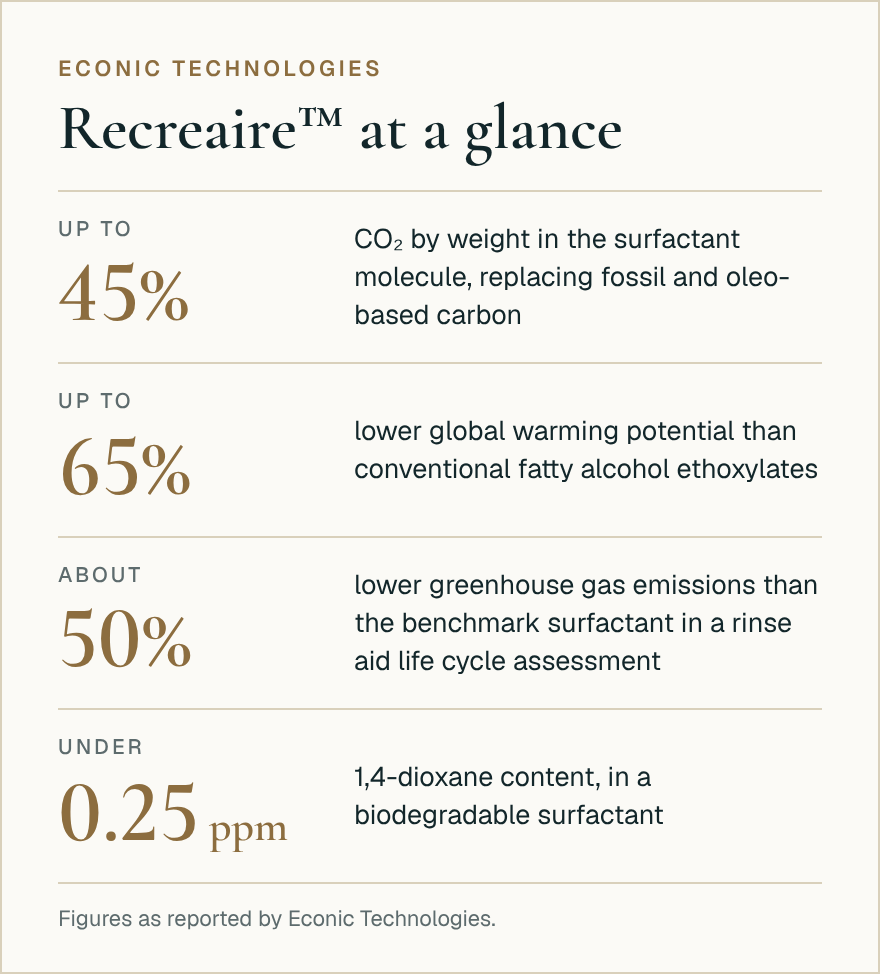
Econic Technologies, a CM Venture Capital portfolio company, has a different answer. Its catalyst technology lets captured carbon dioxide serve as a raw material, and with Recreaire™ it has launched a family of carbonate ethoxylate surfactants built on it. Up to 45% of the weight of the surfactant molecule is CO₂, replacing fossil and oil-based carbon that would otherwise go into it.
Why this matters for such a large industry
A new material only changes the world if it can enter an industry at scale, and surfactants are an industry where scale is the whole point. Brands buy them by the tonne, and they will switch only if a new ingredient works as well, costs a sensible amount and fits the plants they already run. This is where Econic’s approach is strongest. Recreaire is designed to be compatible with existing alkoxylation infrastructure, so surfactant makers do not need to build new plants to make it, and it works in nonionic, anionic and cationic formulations.
The product is also built for today’s regulation and consumer expectations. Recreaire surfactants are biodegradable and very low in 1,4-dioxane, below 0.25 ppm in Econic’s data. This is a by-product that conventional ethoxylation can leave behind and that formulators increasingly have to manage. Because the carbon comes from captured CO₂ rather than from crops, it also avoids the competition with food systems that bio-based surfactants can raise.
The climate case rests on independent life cycle analysis. Econic reports global warming potential up to 65% lower than conventional fatty alcohol ethoxylates, the workhorse surfactants that Recreaire is designed to replace. For brands under growing pressure to cut the footprint of their products, that is a rare lever: it changes what is inside the product without asking the customer to change anything.
Proof in real formulations
Environmental responsibility and commercial viability can go hand in hand.
The test of a sustainable ingredient is whether it performs. Econic recently benchmarked Recreaire in automatic dishwashing rinse aids, one of the more demanding uses for nonionic surfactants, which need low foam, effective wetting and stability at low use levels in hard water. In a neutral rinse aid, Recreaire matched an industry-standard low-foaming surfactant and left glassware visibly clean. In acidic formulations its performance was close to the conventional benchmark, covering the pH range of typical commercial rinse aids.

The formulation work also showed flexibility. Recreaire systems formed clear dispersions when hydrotropes were included, and workable formulations without hydrotropes were demonstrated as well, which gives brands room to balance clarity, cost and ingredient lists. Econic’s life cycle assessment of the rinse aid points to about 50% lower greenhouse gas emissions than the industrial surfactant used in the benchmark formulation.
From dishwashers to skin and hair care
Econic is now taking the technology into personal care. Its newest product, Recreaire 17RC28, launched in September 2026, is an ultra-mild surfactant and emulsifier containing 28% CO₂ by weight, designed for lotions, creams, shampoos and conditioners. Econic says it lowers the carbon footprint of the formulations it goes into by roughly 25% compared with standard surfactants. Beyond cleaning and personal care, the platform is aimed at coatings, agrochemicals and metalworking.
Why we back companies like Econic
At CM Venture Capital we look for technologies that change an industry from the inside. Econic fits that description: a catalyst technology that uses a waste gas as a raw material, a product that drops into the plants and formulations the industry already has, and results that stand up against the incumbent in real tests. It is a company doing something good for the world by bringing low-carbon technology to one of the largest and most familiar corners of the chemical industry, and Recreaire is a clear sign that sustainability and commercial viability can move together. We are proud to be an investor, and we look forward to following Econic’s progress.